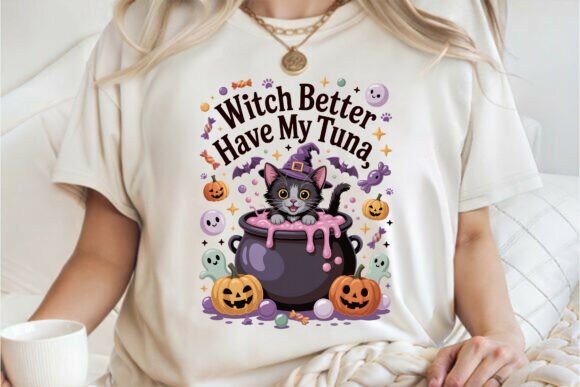
Witch Better Have My Tuna Cat Tee PNG
A Designer’s First Look: Playful, Punchy, and Ready for Stitching
When Witch Better Have My Tuna Cat Tee PNG landed in my inbox, I paused mid-coffee sip—not because it’s overly complex, but because its energy is so instantly legible. It’s a tight, centered composition: a stylized black cat wearing a tiny witch hat, with bold, rounded lettering that wraps the phrase like a spell cast in ink. There’s no background clutter, no extraneous flourishes—just confident negative space and strong silhouette contrast. As an embroidery designer who tests hundreds of graphics each season, I immediately saw its potential for clean, high-impact stitching on cotton tees, canvas totes, and even lightweight denim aprons.
Real Project Test: Embroidering a Custom Witchy Tote for a Local Boutique
Last week, I prepped Witch Better Have My Tuna Cat Tee PNG for a small-batch embroidered tote order—12 natural canvas bags for a neighborhood gift shop launching their Halloween collection. I opened the transparent PNG in my digitizing software, traced the outlines, and ran a quick stitch simulation. What stood out? The cat’s face has just enough detail to read clearly at 3.5” wide (ideal for tote front panels), and the lettering uses thick, consistent strokes—no hairline serifs or fragile joins that vanish under satin stitch. It stitched cleanly on medium-weight tear-away stabilizer, with zero thread breaks or puckering. Customers loved how the design held its personality without looking “busy”—a rare win for text-forward graphics in machine embroidery.
Where This Design Shines—and Where It Needs Care
Witch Better Have My Tuna Cat Tee PNG excels on stable, flat surfaces: t-shirts, sweatshirt fronts, pillow covers, tea towels, and baby onesies (with soft stabilizer and low-density fill). Its bold shape translates well into applique design, too—I’ve already used it as a base for a fused-felt patch version on denim jackets. It’s also a smart choice for holiday embroidery: think embroidered kitchen towels for October hosting, or mini versions on stocking stuffers.
But here’s where practical judgment kicks in:
- Caps and curved surfaces: Avoid placing it across the crown or bill—it’s not optimized for distortion. Stick to front panels only.
- Thin or stretchy fabrics: On jersey or ribbed knits, use cut-away stabilizer and reduce stitch density slightly to prevent shadowing or stretching.
- Dark fabric backgrounds: The design relies on contrast—the cat and text need breathing room. Always test thread colors (e.g., charcoal gray on navy, bright orange on black) before full production.
- Small hoop sizes: Below 4” height, some letter spacing tightens; preview at actual size before hooping.
- Frequent-wash items: For baby embroidery or kitchen towels, reinforce satin-stitched edges with a light running stitch outline to extend durability.
What It Adds to Your Handmade Product—and What It Doesn’t Promise
This isn’t a “design-and-forget” file—but it *is* a thoughtful, commercially viable starting point. When stitched well, Witch Better Have My Tuna Cat Tee PNG lifts the perceived value of a simple tote or tee from “cute” to “curated.” Customers recognize the wit and craftsmanship instantly—especially if you pair it with quality thread and tidy finishing. It builds trust: buyers see intention, not clipart. For Etsy sellers and craft fair vendors, it’s a reliable anchor design—versatile enough for seasonal listings, yet distinct enough to stand out in a sea of generic cat motifs.
That said, it won’t magically fix poor digitizing choices. If you’re new to embroidery file prep, don’t assume the PNG will stitch flawlessly straight from download. You’ll still need to digitize it properly—or hire someone who does—for real-world wear. And while it works beautifully as a digital embroidery file, remember: this is a Graphics asset, not a pre-digitized embroidery file. Always confirm licensing terms before selling finished products or bundling it into digital product kits.
Practical Notes Every Embroidery Designer Should Run Before Stitching
- Test on scrap fabric matching your final product’s weight and weave.
- Check thread color contrast against both light and dark mockups—not just on screen.
- Review stitch density: dense fills work on stable fabrics, but lighten them for baby embroidery or textured weaves.
- Confirm hoop size compatibility—especially if layering with other elements (e.g., a moon icon beside the cat).
- Inspect corners and inner curves: ensure no tiny gaps or overlapping stitches that could snag.
- Run black-and-white and grayscale previews to verify readability at smaller scales.
- Use appropriate stabilizer—cut-away for knits, tear-away for wovens, mesh for lightweight linens.
- Verify commercial use rights before listing on Etsy, Redbubble, or wholesale platforms.
Final Thought: A Design That Feels Like a Conversation Starter
I keep Witch Better Have My Tuna Cat Tee PNG in my go-to folder for lighthearted, audience-friendly projects—especially when clients want something that balances humor and craftsmanship. It doesn’t try to be everything. It’s not minimalist enough for luxury branding, nor detailed enough for fine-art embroidery—but it’s exactly right for handmade product lines that value clarity, charm, and stitchable reliability. Whether you’re building a craft business, personalizing gifts, or refreshing your boutique’s seasonal merch, this graphic earns its place—not as filler, but as a functional, expressive tool. Just treat it like the solid T-Shirt Designs foundation it is: test it, tailor it, and let its personality shine through the thread.